Thursday, July 26, 2012

International Hotel Chains in Sri Lanka


A number of international hotel chains have recognised the infinite potential of the tourism industry in Sri Lanka. Many of the world’s biggest brands have shown interest in opening luxury hotels in the island.

The global giant Starwood Hotels and Resorts Worldwide, the owners of the famous Sheraton brand has made an investment of USD 80 million. The Sheraton Colombo will be a 306-room hotel which will include a Presidential Suite as well as a number of other themed suite rooms. The property will house 4 restaurants and will be located in central Colombo. The Sheraton Colombo is expected to open its doors in October 2013.

Another leading hotel brand, Shangri-La Hotels and Resorts has made an investment of USD 550 million on its first ever hotel project in Colombo. The hotel will overlook the famed Galle Face Green promenade and is projected to be complete by the end of 2015. Offering some of the largest hotel rooms in the city, each room will be approximately 484 square feet by 592 square feet. The Shangri-La Colombo will include a wide range of specialty restaurant concepts and numerous dining opportunities.


The most recent chain of hotels to join in on the bandwagon is the Hyatt Hotels and Resorts Group. The Hyatt Regency Hotel will be a 43 story luxury 5 star property. The property is expected to feature 565 rooms, banquet facilities, numerous food & beverage outlets and a fitness centre.

Foreign investment continues to flood in as Sri Lanka’s popularity in the tourism and leisure sector grows. The industry benchmark in terms of product offered and service standard will be raised, with well established international brands joining in and heightening competition amongst city hotels.


Wednesday, July 25, 2012

Chicken Curry for the Soul

Sri Lankan’s pride themselves in being culinary experts when it comes to rice and curries. We boast of the most flavourful curries that are a complex blend of spices ingeniously layered to form a fiery explosion of deliciousness. Once you try a typical traditional Sri Lankan curry, you will never turn back – I kid you not!

Rice is the staple diet for most Sri Lankans and is eaten with a variety of curries that are prepared in different methods. Various spicy condiments or ‘sambols’ also accompany any meal, adding that extra bit of punch (in the guts?) to your meal!

If rice does not interest you, do not fret! You can try out other traditional specialties such as string hoppers (a stringy noodle made out of wheat flour), hoppers (a crispy bowl shaped pancake), roti (flat bread) and thosai (a savory pancake).
Additionally Sri Lankan cuisine has been heavily influenced by Western invaders (Dutch and Portuguese), South Indians as well as Arab tradesmen.

Biriyani is an aromatic rice dish. What makes biriyani unique is the fragrant stock that the rice is cooked in. This stock is prepared with a number of various spices and meat that complement the rice perfectly. This delectable dish is extremely popular and enjoyed by all Sri Lankans.

Lamprais is yet another way of preparing rice, influenced by the Dutch. The rice is prepared in a complex mixture spices, turmeric and coconut milk. Once again the stock plays an extremely important role in its preparation, with a combination of meat being added to enhance the flavours. A number of different curries and sambols are added as accomplishments and it is packaged and served in a banana leaf. Among these curries and side dishes is blachang (a ball of finely ground prawns), frikadels (crumb fried meat balls) and brinjal pahi (brinjal fingers fried in traditional spices).

Yes, in case you didn’t believe me the first time, Sri Lanka is definitely a foodies haven. Explore the complex flavours and exotic spices of Sri Lankan cuisine and prepare to be delighted!

In the West, people often crave a warm comforting bowl of hot soup after a hard days work or when sick. Unsurprisingly this is not the case with me. As a Sri Lankan, I crave chicken curry! I yearn for a thick steaming curry comprising of tender chicken, coconut milk, garlic, cinnamon sticks, ginger, chilli powder and a number of other spices.
I believe a chicken curry a day will most definitely keep the doctor away! So forget the soulful chicken soup of yesteryear and try our chicken curry!


Here’s the recipe for those of you who would like to try it out for yourselves.


RECIPE FOR CHICKEN CURRY

Serves 4

Ingredients:-

1 large broiler chicken
1 cup thick coconut milk
2 cups diluted coconut milk
1 sprig curry leaves
1 small stem of lemon grass, chopped
1 large onion, chopped fine
2” piece of ginger, crushed
6 cloves garlic, chopped
4 cardamoms
4 cloves
3” piece of cinnamon, broken up
3 heaped teaspoons roasted curry powder
3 teaspoons chillie powder
½ teaspoon saffron
Salt and pepper
Juice of 2 limes
2 tablespoons oil

Method:-

Remove outer skin of chicken. Cut into 2” cubes or pieces. Season with salt and pepper. Heat oil and then lightly fry onions, garlic and ginger until translucent. Add curry leaves, lemon grass and cook for a minute. Next add pieces of chicken. After a minute, add diluted coconut milk, curry powder, saffron and chillie powder. Allow to simmer until chicken is cooked. Add spices and the thick coconut milk followed by lime juice. Taste and add more salt if required. Simmer on a low fire until the gravy is thick.

Sunday, July 22, 2012

Time to grab that snorkelling mask!


It's the perfect time of year for snorkelling in Trincomalee. This shot was taken off the the cliff of the Koneswaran Temple. I happened to noticed a couple of people snorkelling by the rocks. Unfortunately since I was leaving for Colombo I could not do the same, but I'm sure they must have spotted the most colourful coral and exotic fish!

Enticing don't you think?

Thursday, July 19, 2012

Outbound training

Last weekend the Leisure Inbound team headed to Chaaya Tranz Hikkaduwa, for our annual outbound training. It was a wonderful change for many, who spend most of their days planning exciting tours for others. I won’t lie, the schedule was rather strenuous and the heat did get the better of us all! But we left Hikkaduwa with some food for thought. These fun-filled activities were used as a starting point to foster team spirit and also to highlight the importance of creating a culture that is conducive to change through effective and open communication.
Whilst this trip was all about building team spirit, we did manage to have a bit of fun at our social as well! 
Just thought I would share a few pictures of us hard at work!


Have a great weekend all! :)

Sunday, June 24, 2012

CASA Colombo

This retro-chic hotel is making headlines the world over! Winner of the ‘2011 Asia Pacific Hotel Award’ for ‘Best Interior Design’ and ‘2011 Trip Advisor Certificate of Excellence’.

Additionally the hotel has been nominated for the titles of Asia’s Leading Boutique Hotel, Sri Lanka’s Leading Hotel and Sri Lanka’s Leading Business Hotel (World Travel Awards 2012).

The hotel is located in the heart of Colombo, easily accessible as it is just off the
Galle Road.
Casa Colombo is a 200 year old mansion that has been painstakingly restored and is now a vibrantly luxurious boutique property. What’s unique about the property is its eclectic style that has a youthful appeal, nothing like Colombo has ever seen before.

Surround yourself with stylish living spaces, mosaic flooring, elaborate embellished materials and muted lighting that creates an intimate atmosphere. Each guest has their own personal Domo who will attend to their every whim and fancy. Lounge on one of the white poolside beds right next to the exclusive pink pool and taste delicacies from around the world, in a decidedly different ambiance!


The Library
 
                       Casa Colombo has 12 uniquely designed suites that excude comptemporary style


White poolside beds


HVN Restaurant

Dusk at CASA Colombo


The exclusive pink pool


Art Installation

Verandah


Tuesday, June 12, 2012

Minneriya National Park

If you wish to view large herds of Sri Lanka’s gentle giants, then your best bet would be to head over to the Minneriya National Park between the months of July and September. It is between these months that the dry season kicks in and the elephants migrate to the park in search of water. The Minneriya Tank retains water throughout this season and proves to be the ideal thirst quencher! These elephants are said to migrate to Minneriya from surrounding parks like Wasgamuwa and Kaudulla National Parks. During this season, up to 200 wild Asian Elephants are seen grazing around the tank or taking a cool dip in the water to relieve themselves from the sweltering heat. This phenomenon is known as ‘The Gathering’.


Although I did not get the opportunity to view The Gathering at its prime in the month of August, I was able to make my way to Minneriya late last month and was pleasantly surprised! We headed to the park early evening, as we were told that the elephants begin to wander out of the thick jungle at this time since it’s always much cooler. As our jeep ambled its way through the jungle and onto the open plains overlooking the glistening Minneriya Tank, we were heralded by a herd of 20 to 30 elephants.

The sheer excitement of seeing these wonderful beasts in their natural habitat is undeniable, even for someone who has been on elephant safari before. Observing the herd closer we were able to make out individual family units including the mothers, young calves and the dominant matriarch of the herd. As we all twisted and turned, bending over backwards in order to capture that perfect shot, I began to realise that this is how elephants should ideally be viewed. Not covered in bejeweled drapery (although this is also quite a site), but in their natural habitat. Enthralled, I watched a baby calf covered in fuzzy fluff hide behind its mother whilst two calves playfully charged at one another ending up in a gridlock in the distance.


Other than these majestic beasts, the park itself makes for an interesting evening visit. Not only is the topography entirely different to the shrub jungle you would usually see in the popular Yala National Park, but this park is also home to many other animals – specifically a vast array of beautiful birds, Sambar deer and a number of interesting reptiles and amphibians. Thick dense jungle makes it slightly harder to spot the animals, however when you do it is an entirely rewarding experience. Meandering along the red earth pathways you will occasionally notice the fragrant smell of pine needles- a welcome aroma from the perfume of pungent elephant dung!


As if life couldn’t get any better, we were able to catch the rosy-pink blushing sky cast its glow over the glinting Minneriya Tank. What better way to end a day, with the company of one the worlds largest land mammals plodding along in the distance!


Monday, May 28, 2012

Here comes the sun...
...And I say,
It's all right
--------------------
I've become obsessed with the setting sun. Hard not to be with magical moments like these seen all year round!

Wednesday, May 16, 2012

Wish upon a star


The view of the sunset at Negombo Beach. Notice the first star making its shining appearance amidst the glowing orange rays of the setting sun.

Friday, May 4, 2012

How to make a Vesak Lantern

Gearing up for the weekend’s celebrations, I thought it would be fitting to make a Vesak Lantern for our office cubicle. This was my first attempt at making one, although I must admit I did cheat a tad bit here and there in order to speed up the process. I will now share an easy, step by step guide on how to make a Vesak Lantern.

Below is a list of materials that you will need:
24/25 Strips of bamboo
Thread
Thin tissue paper/ crepe paper
A pair of scissors
Glue/ Paappa (traditional glue made out of plain baking flour and water)


Making the frame

Alright alright, I didn’t make the frame- I bought it off the roadside. But if you wish, you can make one on your own using bamboo sticks (as they are easily bendable) that are cut thin to around 0.5 inch/ 1 cm in diameter. Each stick should measure roughly around 15cms in length making it a manageable size to start off with. Lanterns range in shape and size from simple rectangles or prisms to highly elaborate structures.


All you need to do is take your thin strips of bamboo and tie them tight together with some sturdy thread to form the shape you desire. Let your imagination run wild and come up a whimsically, unique design! (Unlike me)


Making Paappa


This disgustingly gloopy stuff is thoroughly fun to play around with! All you need to do is mix baking flour and water and heat it over the fire until it becomes suitably gooey. Why paappa over glue? The thick paste aids in handling the thin Tissue paper that could easily tear when using glue.


Decorating the frame


Easily the most fun part! Traditionally white tissue paper was used; however you can jazz it up by using various bright colours just like I did. Try not to stick to one colour!

Step 1: Trace the outline of the frame onto the paper leaving about a 1cm leeway, which can be trimmed off later.


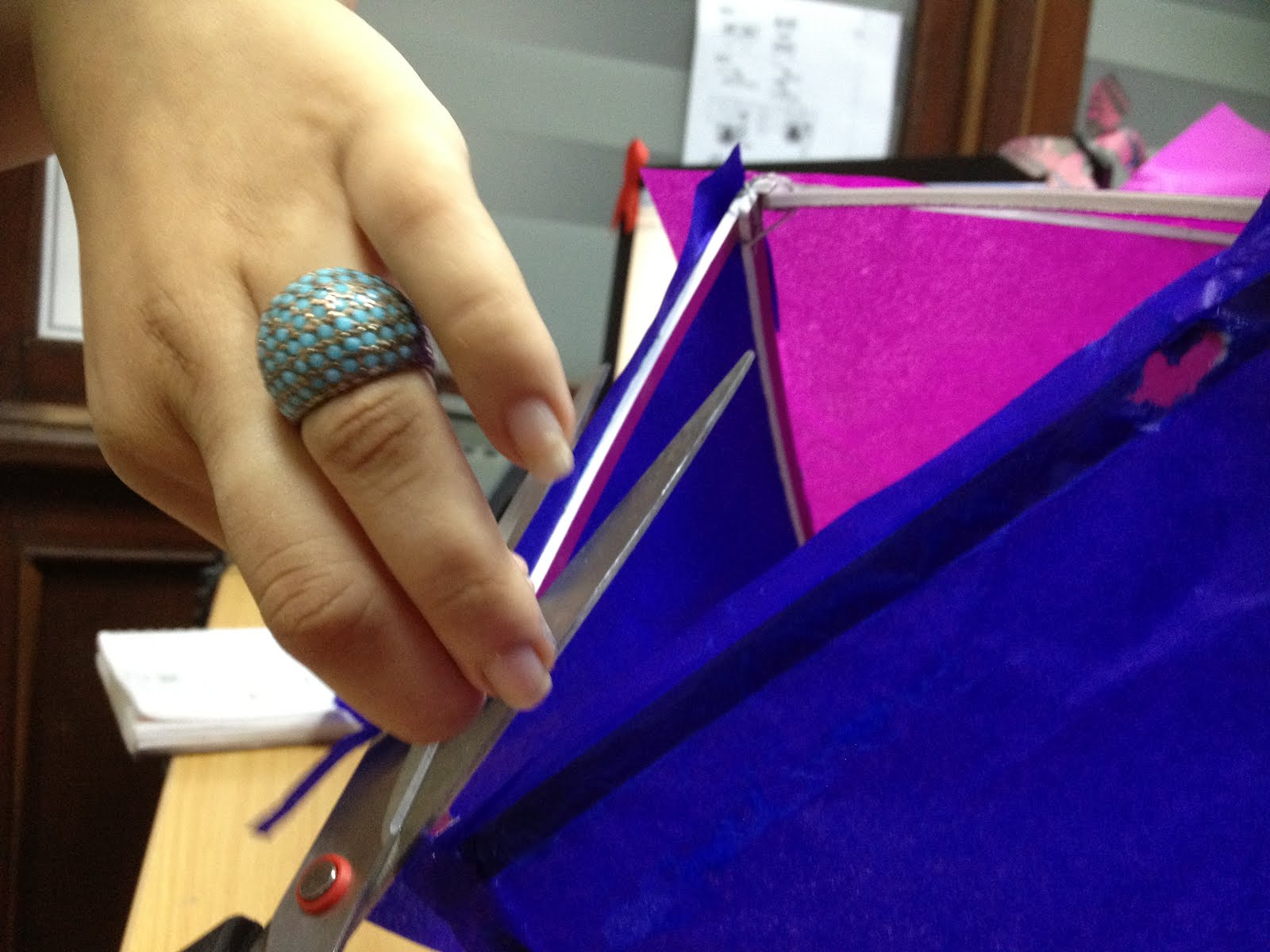
Step 2: Apply the thick paste onto the frame and slowly place the cut piece of crepe paper onto the bamboo.


Step 3: Let the lantern dry out and then slowly trim away the excess tissue paper off the edges.


Step 4: Cut thin long strips of paper.

Step 5: Apply paappa to the edges of the lantern and then slowly scallop the thin strips of paper over, neatening out the entire look.


The final step: making tentacles for the lantern!
Step 6: Fold a long strip of paper up several times. Instead of cutting clear through the folded paper, leave some room at the top, and nip the folded part many times to create thin strips. Afterward gently shake the folded paper out and paste the tentacles onto the insides of the lantern!


Voila! You’re done!


Thursday, May 3, 2012

Jambu

Yes we Lankan's love our spicy food! We will even resort to eating Jambu's (an exotic fruit found mainly in South East Asia) with chilli powder and salt! What a scrumptious snack! Hooray for Jambu season :)

Wednesday, May 2, 2012

Koneswaram Kovil, Trincomalee

Considered one of the most important religious monuments in Sri Lanka, the Koneswaram Kovil (also known as Tirukonamamalai Konesar Kovil or the Temple of the Thousand Pillars) is perched atop a rocky promontory, Swami Rock, overlooking the harbor of Trincomalee. The kovil’s primary deity is the Hindu deity Shiva, who is the Destroyer or Transformer amongst the Divine Hindu trinity. This kovil traces its roots back to as far as the 3rd century.

Over the years the temple was restored by many Sri Lankan Kings as well as Chola invaders of South India, who left their own architectural mark, creating an eclectic and unique religious monument. However the kovil was completely destroyed by the Portuguese when invading Fort Frederick, between the years 1622 and 1624. Evidence suggests that the temple was pushed over Swami Rock into the plummeting depths of the Indian Ocean below. Ancient ruins have been unearthed from underwater by famous science fiction author Arthur C Clarke, the most important find being the lingam, believed to be Swayambhu.

When my friend informed me that we would be making a day trip to Trincomalee, I insisted we visit the temple. Walking up the winding path that leads up to the Koneswaram Kovil, you are greeted with a variety of stalls selling everything from statues of Hindu deities, fresh fruit to quench your thirst and local sweets to munch on. We take off our shoes near the gate and climb up the steps leading to the temple. A massive golden statue of Shiva which was recently erected stands tall against the blue sky. I stand at the foot of the statue feeling rather overwhelmed by its size.

I am greeted by the soothing scent of incense as I walk into the temple, which is scattered with both worshippers and tourists just like me. Intricate statues of numerous Hindu deities dance across the walls of the kovil, treating the eye to an explosion of vivid colour. Legend has it that Lord Ravana (from the popular Indian epic of the Ramayana) worshipped Shiva at this very temple. As he was leaving the temple Ravana dropped his sword and so ‘Ravana Cleft’ was formed. Although I am uncertain of the accuracy of this legend, I can attest to the fact that I felt a calming presence within the safe walls of temple and the surrounding compound. I might not be Hindu, but I was certain a higher power was within our midst.

In the Shaiva tradition of Hinduism, Shiva is considered the Supreme God, whilst all other deities are lower manifestations of Shiva. According to Shaivism, Shiva has five important works including being the creator, preserver, destroyer whilst also concealing and revealing prophecies.


Wandering through the temple complex I marvel over the hands that created the complex statues and artwork that adorn the walls and at how wonderfully most of these ancient sculptures have been preserved over the decades. I can only imagine the havoc that was caused when the entire temple was invaded and destroyed. Today the kovil stands majestically, overlooking the glistening ocean. One can’t help but be enthralled by the mystical element that is associated with the history of the temple, including prophesies that have been discovered and revealed, along with all the secrets that it safely conceals.


Entrance to Fort Frederick


Colourful stalls lining the streets including a stall that sold various religious posters.


Ravanas Cleft


Golden statue of Shiva


Entrance to the kovil


The mystical Lord Ravana