Tuesday, June 12, 2012

Minneriya National Park

If you wish to view large herds of Sri Lanka’s gentle giants, then your best bet would be to head over to the Minneriya National Park between the months of July and September. It is between these months that the dry season kicks in and the elephants migrate to the park in search of water. The Minneriya Tank retains water throughout this season and proves to be the ideal thirst quencher! These elephants are said to migrate to Minneriya from surrounding parks like Wasgamuwa and Kaudulla National Parks. During this season, up to 200 wild Asian Elephants are seen grazing around the tank or taking a cool dip in the water to relieve themselves from the sweltering heat. This phenomenon is known as ‘The Gathering’.


Although I did not get the opportunity to view The Gathering at its prime in the month of August, I was able to make my way to Minneriya late last month and was pleasantly surprised! We headed to the park early evening, as we were told that the elephants begin to wander out of the thick jungle at this time since it’s always much cooler. As our jeep ambled its way through the jungle and onto the open plains overlooking the glistening Minneriya Tank, we were heralded by a herd of 20 to 30 elephants.

The sheer excitement of seeing these wonderful beasts in their natural habitat is undeniable, even for someone who has been on elephant safari before. Observing the herd closer we were able to make out individual family units including the mothers, young calves and the dominant matriarch of the herd. As we all twisted and turned, bending over backwards in order to capture that perfect shot, I began to realise that this is how elephants should ideally be viewed. Not covered in bejeweled drapery (although this is also quite a site), but in their natural habitat. Enthralled, I watched a baby calf covered in fuzzy fluff hide behind its mother whilst two calves playfully charged at one another ending up in a gridlock in the distance.


Other than these majestic beasts, the park itself makes for an interesting evening visit. Not only is the topography entirely different to the shrub jungle you would usually see in the popular Yala National Park, but this park is also home to many other animals – specifically a vast array of beautiful birds, Sambar deer and a number of interesting reptiles and amphibians. Thick dense jungle makes it slightly harder to spot the animals, however when you do it is an entirely rewarding experience. Meandering along the red earth pathways you will occasionally notice the fragrant smell of pine needles- a welcome aroma from the perfume of pungent elephant dung!


As if life couldn’t get any better, we were able to catch the rosy-pink blushing sky cast its glow over the glinting Minneriya Tank. What better way to end a day, with the company of one the worlds largest land mammals plodding along in the distance!


Monday, May 28, 2012

Here comes the sun...

...And I say,
It's all right
--------------------
I've become obsessed with the setting sun. Hard not to be with magical moments like these seen all year round!

Wednesday, May 16, 2012

Wish upon a star


The view of the sunset at Negombo Beach. Notice the first star making its shining appearance amidst the glowing orange rays of the setting sun.

Friday, May 4, 2012

How to make a Vesak Lantern

Gearing up for the weekend’s celebrations, I thought it would be fitting to make a Vesak Lantern for our office cubicle. This was my first attempt at making one, although I must admit I did cheat a tad bit here and there in order to speed up the process. I will now share an easy, step by step guide on how to make a Vesak Lantern.

Below is a list of materials that you will need:
24/25 Strips of bamboo
Thread
Thin tissue paper/ crepe paper
A pair of scissors
Glue/ Paappa (traditional glue made out of plain baking flour and water)


Making the frame

Alright alright, I didn’t make the frame- I bought it off the roadside. But if you wish, you can make one on your own using bamboo sticks (as they are easily bendable) that are cut thin to around 0.5 inch/ 1 cm in diameter. Each stick should measure roughly around 15cms in length making it a manageable size to start off with. Lanterns range in shape and size from simple rectangles or prisms to highly elaborate structures.


All you need to do is take your thin strips of bamboo and tie them tight together with some sturdy thread to form the shape you desire. Let your imagination run wild and come up a whimsically, unique design! (Unlike me)


Making Paappa


This disgustingly gloopy stuff is thoroughly fun to play around with! All you need to do is mix baking flour and water and heat it over the fire until it becomes suitably gooey. Why paappa over glue? The thick paste aids in handling the thin Tissue paper that could easily tear when using glue.


Decorating the frame


Easily the most fun part! Traditionally white tissue paper was used; however you can jazz it up by using various bright colours just like I did. Try not to stick to one colour!

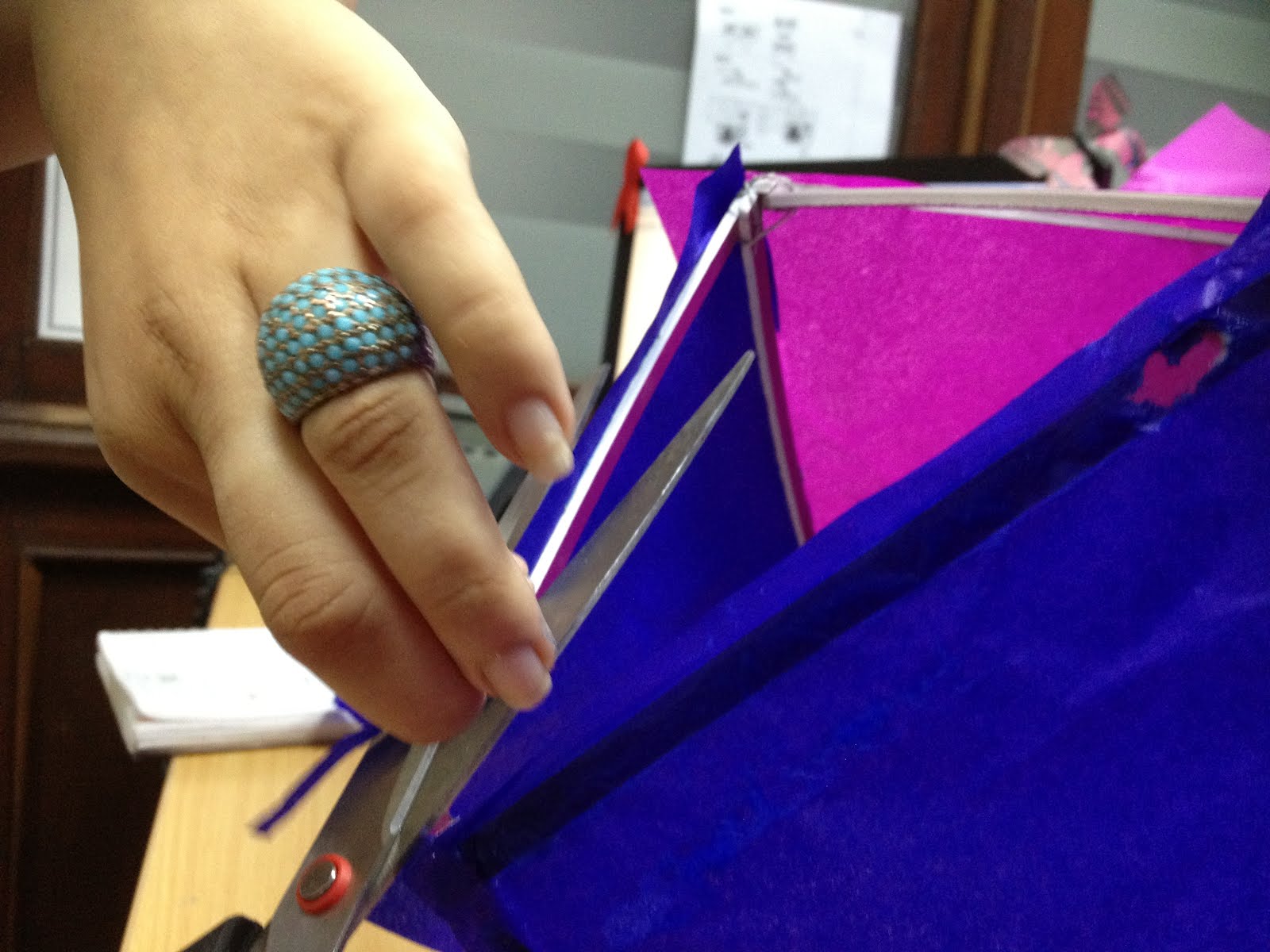
Step 1: Trace the outline of the frame onto the paper leaving about a 1cm leeway, which can be trimmed off later.


Step 2: Apply the thick paste onto the frame and slowly place the cut piece of crepe paper onto the bamboo.


Step 3: Let the lantern dry out and then slowly trim away the excess tissue paper off the edges.


Step 4: Cut thin long strips of paper.

Step 5: Apply paappa to the edges of the lantern and then slowly scallop the thin strips of paper over, neatening out the entire look.


The final step: making tentacles for the lantern!
Step 6: Fold a long strip of paper up several times. Instead of cutting clear through the folded paper, leave some room at the top, and nip the folded part many times to create thin strips. Afterward gently shake the folded paper out and paste the tentacles onto the insides of the lantern!


Voila! You’re done!


Thursday, May 3, 2012

Jambu

Yes we Lankan's love our spicy food! We will even resort to eating Jambu's (an exotic fruit found mainly in South East Asia) with chilli powder and salt! What a scrumptious snack! Hooray for Jambu season :)

Wednesday, May 2, 2012

Koneswaram Kovil, Trincomalee

Considered one of the most important religious monuments in Sri Lanka, the Koneswaram Kovil (also known as Tirukonamamalai Konesar Kovil or the Temple of the Thousand Pillars) is perched atop a rocky promontory, Swami Rock, overlooking the harbor of Trincomalee. The kovil’s primary deity is the Hindu deity Shiva, who is the Destroyer or Transformer amongst the Divine Hindu trinity. This kovil traces its roots back to as far as the 3rd century.

Over the years the temple was restored by many Sri Lankan Kings as well as Chola invaders of South India, who left their own architectural mark, creating an eclectic and unique religious monument. However the kovil was completely destroyed by the Portuguese when invading Fort Frederick, between the years 1622 and 1624. Evidence suggests that the temple was pushed over Swami Rock into the plummeting depths of the Indian Ocean below. Ancient ruins have been unearthed from underwater by famous science fiction author Arthur C Clarke, the most important find being the lingam, believed to be Swayambhu.

When my friend informed me that we would be making a day trip to Trincomalee, I insisted we visit the temple. Walking up the winding path that leads up to the Koneswaram Kovil, you are greeted with a variety of stalls selling everything from statues of Hindu deities, fresh fruit to quench your thirst and local sweets to munch on. We take off our shoes near the gate and climb up the steps leading to the temple. A massive golden statue of Shiva which was recently erected stands tall against the blue sky. I stand at the foot of the statue feeling rather overwhelmed by its size.

I am greeted by the soothing scent of incense as I walk into the temple, which is scattered with both worshippers and tourists just like me. Intricate statues of numerous Hindu deities dance across the walls of the kovil, treating the eye to an explosion of vivid colour. Legend has it that Lord Ravana (from the popular Indian epic of the Ramayana) worshipped Shiva at this very temple. As he was leaving the temple Ravana dropped his sword and so ‘Ravana Cleft’ was formed. Although I am uncertain of the accuracy of this legend, I can attest to the fact that I felt a calming presence within the safe walls of temple and the surrounding compound. I might not be Hindu, but I was certain a higher power was within our midst.

In the Shaiva tradition of Hinduism, Shiva is considered the Supreme God, whilst all other deities are lower manifestations of Shiva. According to Shaivism, Shiva has five important works including being the creator, preserver, destroyer whilst also concealing and revealing prophecies.


Wandering through the temple complex I marvel over the hands that created the complex statues and artwork that adorn the walls and at how wonderfully most of these ancient sculptures have been preserved over the decades. I can only imagine the havoc that was caused when the entire temple was invaded and destroyed. Today the kovil stands majestically, overlooking the glistening ocean. One can’t help but be enthralled by the mystical element that is associated with the history of the temple, including prophesies that have been discovered and revealed, along with all the secrets that it safely conceals.


Entrance to Fort Frederick


Colourful stalls lining the streets including a stall that sold various religious posters.


Ravanas Cleft


Golden statue of Shiva


Entrance to the kovil


The mystical Lord Ravana


Friday, April 27, 2012

Road Trip

This weekend a friend and I are heading towards Habarana, located in the North Central Province of Sri Lanka. We've made our first pitstop at Ambepussa Rest House for breakfast. We were pleasantly surprised to be greeted by the soothing melodic folk tunes, courtesy of the resident flautist, perched on top of a tree! Good Morning :)

Monday, April 23, 2012

Unawatuna Beach

Hello all!

A couple of friends and I headed down south to Unawatuna Beach last weekend. With the opening of the Southern Expressway the journey is slightly over one hour - a great improvement from the 3 and a half hour -long expedition we once had to take!

Approaching the entrance to the Southern Expressway is still rather chaotic, but nothing your experienced Walkers Tours guide can't handle really!


Although the month of April is technically off season for south coast beaches and the ominous cumulonimbus clouds hung over us for most of the day, we were able to experience a typical rose-hued Unawatuna-bay sunset! Très Magnifique!


Photo credit: Annelie Wambeek

I simply HAVE to mention these mouth wateringly-delicious banana fritters we gobbled up at Full Moon Resort, Unawatuna. The gooey bananas encapsulated by crispy golden batter, topped off with warm kithul pani ( Sri Lankan treacle) and a scoop of vanilla ice cream were #TODIEFOR!


Have a great week! :)

Tuesday, April 10, 2012

Sinhala and Tamil New Year

It’s that time of year again when shops close down, a serene calmness hangs over the city of Colombo and the sweet aroma of fresh Konde kavun and Asmi wafts through the air.
Sri Lanka begins to celebrate Sinhala and Tamil New Year (Avurudu festival) with the distinctive call of the koha (koel bird) that coos only once a year, around this time.

Like many other festivals in Sri Lanka, Avurudu is governed by customary rituals that have been in practice over thousands of years. The New Year dawns at a specific time determined by astrologists. Unlike western calendars, there is a period between the conclusion of the previous year and the beginning of the next. This period is called Nonagatha (neutral period) when the sun moves from the Meena Rashiya (House of Pisces) to the Mesha Rashiya (House of Aries) in the celestial sphere. Individuals are expected to disengage from any form of work and dedicate their time to prayer and religious observance. When this period is over the New Year finally dawns with much celebration. This year the New Year will begin at 7.02 pm on the 13th of April.

Following this, the festivities start with the lighting of the hearth. A pot of milk is placed over the fire as the family gathers around to watch this ritual. If the milk boils over it is a sign of prosperity for the coming year. As with all other customs during this season, every ritual has an auspicious timing and significance – even the colour of the clothing you wear. This year I am told that the auspicious colours are white and light blue.

Another tradition that will take place on the 15th of April is the ‘Hisa tel Gaama’ where the elders of the family bless the younger members by saying ‘Ekasiya vissata desiya vissak Ayuboho vewa!’ Which loosely translates to may you live a long and prosperous life. Interestingly, this is the origin of the word Ayubovan, which is a popular way of greeting one another in Sri Lanka.

Milk rice (kiri bath) is the quintessential festive meal prepared to celebrate the New Year. It is an unsweetened rice pudding that is made with coconut milk and eaten with a variety of spicy condiments. It also happens to be my favourite dish of this festive season!


The New Year does not only involve the exchange of gifts, stuffing yourself to the gills with Sri Lankan delicacies, religious observance / customary rituals and visiting long lost relatives. It is also a time of reflection. Reflecting on the previous year’s achievements and obstacles as well as gearing up the year ahead. Although I might not personally celebrate Avurudu, what I can do is spend my days reflecting on what I hope to achieve in this coming year and most importantly, what I am thankful for - my encouraging family and friends, health and being lucky enough live in this paradise isle.

Happy New Year!

Friday, March 30, 2012

Thala 2012

Roughly translated, Thala means ‘melody’. I was recently treated to a lovely night out at Colombo’s newest theatre- NelumPokunaMahindaRajapaksa Theatre to watch Thala 2012. It was a melodious night indeed, what ensued surpassed all my expectations.

The Channa-Upuli Performing Arts Foundation, a dance institute that has gained major momentum over the recent years, presented Thala 2012. I will be honest; being a dancer myself, I know shockingly little about the oriental dance tradition.
I began my dance career at the wee age of 3 with classical ballet and then proceeded to explore various sub-genres including contemporary, free-style, street jazz, tap and hip-hop. Somehow I never had the chance of learning oriental dance - which is a crying shame really! So when my friend asked me to join him for an evening of oriental dance, I was thrilled to say the least!

Upon entering the theatre I was almost SICK with anticipation. I had heard good reviews about the stage and how spectacular the set designs could get. We sat for a rather long time; I noticed the show was running half an hour behind schedule – typical Sri Lankan tardiness. Eventually, the lights were dimmed and the curtains drawn.

The first act was called ‘A Celestial Overture’, which began with beautiful maidens clothed in pure white, serenely swaying to the music whilst presenting incense sticks and lotus flowers as an offering to the Gods. A lone spotlight hits the stage as the centre opens up, and a richly adorned deity emerges from the bottom of the stage, sitting amidst the petals of a lotus flower. As the maidens worship this divine being, my attention suddenly swings up towards the ceiling. Eight godlike deities begin dancing, suspended midair. A chill creeps up my spine as I watch the entire stage transform into what seems like a scene out of the Mahavamsa. It is then that I realize, whilst every performance that I have been a part of has always had a certain ‘theme’, none really told a story quite like what was unfolding before my eyes.


I watched enthralled as each performance related the most beautiful story. My favourite act of the evening was definitely ‘Pearl of the Indian Ocean’, where a pearl maiden retells the story of how Sri Lanka’s rich culture and civilization was first introduced to the island. The colourful performance included Queen Kuveni, (Sri Lanka’s first historically recorded queen) Kandyan dancers and Kathakali dancers. With the ever-present rhythmic drum beats and symphonic melodies spiraling into a crescendo the dancers stealthily moved across the stage in complete unison. Each story was not simply related through the dancers movements but also emoted through their eyes- be it anger, love, fear or sorrow they wished to portray, I was could truly empathize with each dancers emotional journey.


As a dancer, what impressed me the most was the intricate footwork punctuated with the tinkling bells of the dancers’ brass anklets throughout all the performances. I found myself perched on the edge of my seat watching in horror, as the many taut bodies balanced in backbreaking positions for what seemed like an eternity! With every melodious tune, every leap and graceful turn, I found myself enthralled with this form of dance and its deep-rooted traditions.
This evening was not simply an evening of dance but an educational and spiritual adventure.

Tuesday, March 20, 2012

The Universal Language

It’s 6pm on a tiring, balmy Wednesday. I have just finished work and frankly, I’m not in the best of moods. But then my sister tells me that I should join her on a work assignment. Being a full time journalist, my sister is constantly discovering new places to visit, stumbling across an array of delightful eateries and covering various events.
She mentioned something about a musical event- to be honest I was sold from the get-go!

At the entrance to the hall, I am informed that this show is strictly for invitees. True to form my sister has failed to tell me this, but I put my best journalistic face on and it does the trick!
The hall is jam-packed with people – mostly old I notice. Later I’m told that the show is in celebration of Sri Lankan folk music.


Lights dim, inaugural speeches are made and finally the show commences with the resonating wail of the conch shell. As the curtains swing open, the crowd murmurs in excited anticipation. I am left awe-stuck as I stare, open mouthed, at the hundreds of musicians assembled on stage perfectly poised and ready to burst into melodies from time immemorial.

The rhythmic drum beats, harmonious twang of sitars and symphonic melodies of violins cascading to a euphoric crescendo left me pleasantly speechless. Closing my eyes, I listened with bated breath to colourful tune after tune of traditional folk songs played to perfection, tunes that have been played over countless decades. I open my eyes once again and watch the audience- eyes transfixed on the stage, tapping to the cadenced beats, some even smiling.

Music is a form of therapy for me. A friend once asked me if I could imagine life without music. My answer is no. Without song, my life would lack vigour, movement, passion and spirit. With the escalating rhythm enveloping me, I felt myself letting go of all worldly troubles and sinking into the cathartic beats of the tabla.

Music speaks to ones soul- it crosses ages and cultures. It is the universal language. These folk songs were foreign to me. Most of them being songs you would listen to in a Hindu temple or a traditional Pooja – yet after awhile I found that these songs sounded strangely familiar. A sense of oneness floated around the hall that transcended ethnic backgrounds, a purified sense of belonging not only to Sri Lanka, but humanity.


Music is the universal language of mankind. ~Henry Wadsworth Longfellow, Outre-Mer

Wednesday, March 7, 2012

Mahoora Safari camping

Last weekend, a dozen of our colleagues at Walkers Tours were fortunate enough to experience ‘luxury camping’ slap-bang in the heart of Yala National Park. Now when we first heard about luxury camping, we were rather baffled as nothing seemed more contradictory. However Eco-team really does live up to their promise of offering ‘five star luxury under a million stars’. The meticulous efforts of the friendly staff members is what made luxury camping a truly sumptuous experience.

The journey to our campsite included an hour long drive, as well as an exhilarating off road jeep ride! We marveled over the amenities available in our make shift tents, which included a large bed, a fruit basket, a flushable toilet, wash basin and shower – how ingenious! These tents are handmade in Sri Lanka exclusively for the camp, making it an entirely local, authentic experience. What’s more incredulous is the fact that the entire campsite is set up a mere two days prior to arrival.

The thought of being surrounded by dense jungle is supremely thrilling. Being far away from any signs of civilization, we all seemed to escape from our daily hum-drum routines and plunge into the wilderness that surrounded us. We were delighted to discover that the campsite was situated right next to a fast flowing, shallow river, giving us the added advantage of cooling off when the heat would get the better of us all.

Although travel within the park is included in this package, one does not have to wander far- more often than not the wilderness is bound to find you! However, choosing to opt for a safari, we were lucky enough to spot 4 leopards, a number of elephants, deer, buffalo, crocodiles and a myriad of colourful indigenous birds.

Meals at Mahoora were most astounding, as we were presented with what seemed like an endless stream of delectable courses. Dinner comprised of a 7 course extravaganza – all in the midst of the thick forest! Speechless, we marveled over the array of soups, salads, barbeque platters, local cuisine and delicious dessert presented to us. The highlight of our stay was most definitely breakfast, with the dining table laboriously laid out in the middle of the flowing river! The whole spectacle left us all feeling like blue blooded royalty.

No other adventure tour operator does camping quite like Eco team, as they have proved themselves to be pioneers in the field. The attention to every detail and the immaculate service is a testament to the fact that Eco team provides an unparalleled indulgence.
The fine balance between luxury and a genuine camping experience is mastered so skillfully, that we all found ourselves immersed in the wilderness of the jungle and reluctant to leave!

Breakfast for champions!


Photo credit: Sandeep Jayawardhana

Sunday, February 26, 2012

Some where over the rainbow

Alright, there’s no denying it – traffic can often be overwhelming in Sri Lanka, especially if it is your first visit to the island. You will find yourself swiftly hurled into a car and driven at break neck speed down Negombo Road, to your first destination. You will also begin to notice the car jumps from one lane to another – much like a leaping frog. Yes, we are aware that it’s not the norm for vehicles to stick to one lane. But really, calm down, you’re almost there!

Rush hour traffic can often be a nightmare. Not only are you late, but the guy in front of you is contently sitting in the wrong lane, blocking your way. This can only mean one thing; one must resort to overtaking this imbecile whilst thrusting a fist menacingly at him!

One day I was in a friend’s car on the way back home after work, feeling grumpy and rather tired. That’s when I saw it - the delicate silver lining, that glorious pot of gold- at the end of a beautiful rainbow. No really.


The vibrant colours mystified us and we both sat in silence and marveled at its utter beauty. That’s when I realised it. We all spend too many precious moments complaining about our hum drum lives, when we really should be enjoying the natural beauty that surrounds us. Why is it that it’s always the bad that resonates in our minds at a days end?

Today, on this mundane Monday, I ask you to take a few minutes for yourself. Sit back and think about what you have to be thankful for. Or if you are lucky enough and live on a beautiful island like me, absorb the wonderful scenery that surrounds you. Misty dewy mornings, the warmth of the hot sun on your skin, blazing pastel skies at sunset and every once in awhile – that multi coloured arc that stops you right in your tracks and make you believe in magic, at least for a few seconds that is!

Many apologies for the blurry picture- it was taken off my ipod!

Wednesday, February 15, 2012

Hello world!


Staring out at the concrete jungle sprawling across in front of me, I had never felt further away from home. As my flat mates hurried about, gearing themselves up for yet another day in the urban rat race – I sat in the sweet confines of my room contemplating where I belonged and what my purpose really was. A tough question to answer at the age of 20, then again do we really ever know our purpose in this world?

This is one, among many reasons why I decided to move back home to Sri Lanka, after my 3 years of college education in Singapore. My name is Minal, a 22 year old girl born and bred in Sri Lanka. I have a passion for dance, discovering new music, tasting my country’s culinary delights and exploring my beautiful island.

I have lived and travelled abroad, yet something about this resplendent isle keeps beckoning me, like the pull of a fridge magnet. Maybe it’s the fact that my family lives here, or just the sense of belonging that I yearned for in Singapore. Whatever it is a supreme sense of being connected to my country and its people and the pristine natural beauty of the island is an integral part of why I love this island.

So join me on my travels, my musings and random findings to explore Sri Lanka, through my eyes. Discover quirky factoids and the whimsical fancies of my fellow countrymen that make us uniquely Sri Lankan.